
Puracol Collagen Review: Is It Worth It for Stalled Wounds?
 By Anna Krause October 21, 2026
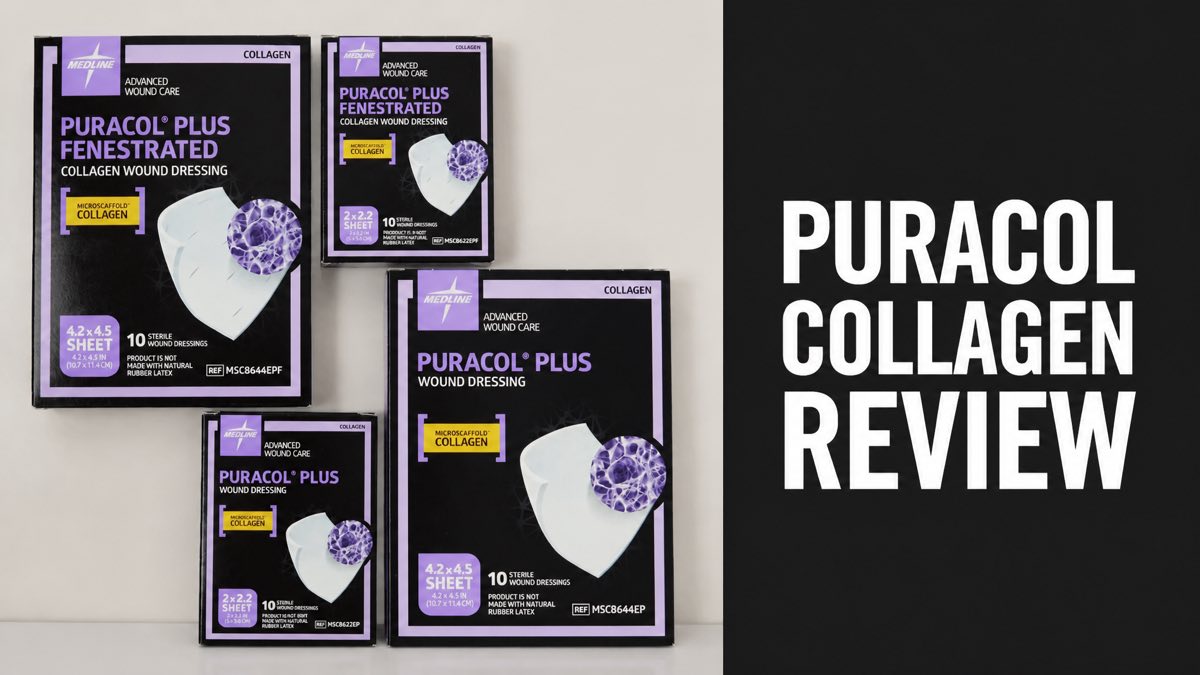
Puracol is a line of sterile collagen wound dressings from Medline, built from 100% native bovine collagen. It is a prescription-labeled medical product for chronic wounds, not a collagen supplement, and that difference trips up many searchers who land here.
The dressing turns to a gel on contact with wound fluid and can stay in place for up to 7 days. It carries labels for pressure, venous, and diabetic ulcers. Silver and powder versions exist. The sheets also come in several sizes. Prices run from about to per sheet, depending on the tier.
The evidence comes mostly from the manufacturer, so the details matter. Read on to learn how Puracol works, what it costs, who must avoid it, and whether it earns a place in a wound care plan for stalled chronic wounds.
What Is Puracol Collagen?
Puracol is a line of sterile collagen wound dressings made by Medline. The sheets use 100% native bovine type I collagen. Clinicians apply them to chronic or stalled wounds that have stopped progressing.
The range includes Puracol, Puracol Plus, Puracol Plus Ag+ with silver, and Puracol Ultra Powder. Each product is latex free. Medline positions the dressings as either a primary or a secondary dressing for all wound types.
Main Formats:
- Puracol base sheet
- Puracol Plus MicroScaffold sheet
- Puracol Plus Ag+ with silver
- Puracol Ultra Powder
Here's why it matters: the manufacturer says the dressing jump starts wounds that are chronic or stalled. A wound care team picks the format by drainage level, infection risk, and wound depth.
Is Puracol a Collagen Supplement?
No. Puracol is a topical medical dressing, not a supplement. Nobody swallows it. The manufacturer labels it Rx only, so a prescriber or licensed professional normally directs its use.
The mix-up comes from the keyword. Searches for puracol collagen overlap with beauty and joint supplement searches. So what is the product, really? A flat sheet in 2 x 2 inch (5 x 5 cm), 4 x 4.5 inch (10 x 11 cm), or 8 x 8 inch (20 x 20 cm) sizes.
How Does Puracol Work?
Puracol turns into a soft gel sheet when it meets wound fluid. The gel stays in contact with the wound bed while it absorbs exudate. Contact with the wound bed is the point of the design.
Native collagen adds structure that supports cell growth. Chronic wounds often carry high levels of enzymes called MMPs. Why does that matter? At elevated levels, MMPs break down viable collagen the body has just built, and added collagen may reduce that excess activity.
Wear time depends on drainage. Why does the range vary? Heavy drainage shortens it, while light drainage lets the dressing stay for up to 7 days.
What Is the MicroScaffold Structure?
The MicroScaffold is a three-dimensional structure built from native collagen. Processing preserves the collagen triple helix. Medline argues that denatured collagen in other products loses that structure.
In plain English, the practical claim is durability. The scaffold is less likely to turn to paste at once or vanish into the secondary dressing. Medline reports a more controlled breakdown in fluid, though the supporting figures are data on file.
Which Puracol Dressings Are Available?
The lineup covers four main formats. Medline sells the base sheet, a thicker Plus sheet, a silver Ag+ version, and a powder. A 1 x 8 inch rope suits narrow or tunneled wounds.
Plus sheets come in 2 x 2.25 inch, 4.25 x 4.5 inch, and 8 x 8 inch sizes. HCPCS billing codes A6021, A6022, and A6023 cover them. The base dressing MSC8544 measures 4 x 4.5 inches and runs 2 mm thick.
For example, dressings can be cut to fit. Deep wounds take layered sheets. The fenestrated Plus sheet adds slits for fluid movement.
What Does Puracol Plus Ag+ Add?
Puracol Plus Ag+ adds antimicrobial silver to the Plus collagen sheet. Clinicians choose it when antimicrobial properties are wanted, such as a heavily colonized wound.
The silver brings an extra restriction. The dressing is contraindicated for active vasculitis and for known sensitivity to collagen or silver. Silver also depletes with use, so each change needs a fresh sheet.
What Wounds Does Puracol Treat?
Puracol Plus is indicated for partial and full thickness wounds. The label also lists pressure injuries, venous ulcers, diabetic ulcers, ulcers of mixed vascular cause, and first and second degree burns.
Donor sites, abrasions, trauma wounds healing by secondary intention, and dehisced surgical wounds complete the list. The sheet manages light to heavy exudate.
Labeled Wound Types:
- Pressure injuries
- Venous ulcers
- Diabetic ulcers
- First and second degree burns
- Donor sites
- Dehisced surgical wounds
But one limit stands out. The product is not indicated for third degree burns.
How Well Does Puracol Work on Stalled Wounds?
Manufacturer data shows positive response rates of 73% and 83% in two studies on chronic wounds. The first study covered severely chronic lower extremity ulcers. A positive response means the wound moved onto a healing trajectory.
A published case series tracked a bovine native collagen dressing for up to 12 weeks. Of the patients treated, 83% closed within 90 days. Fifteen patients healed in 13 to 68 days.
To be clear, the evidence has limits. Is it airtight? No. The studies are small case series and data on file from the maker. No randomized trial against standard care appears in the material.
What Do Puracol Reviews Say?
Public ratings average 4.4 out of 5. Eighty-five percent of them are five stars. Only 13 ratings exist. How much can a score built on 13 ratings prove? Very little.
Wound care clinics describe stronger results on certain wounds. Diabetic foot ulcers, stage III and IV pressure injuries, and venous leg ulcers with higher drainage are the usual wins. Praise centers on the sheet staying intact in the wound bed.
The catch? Independent patient reviews are scarce. Most pages are supplier descriptions of the product rather than personal accounts.
What Are the Common Drawbacks?
The biggest drawback is the mandatory secondary dressing. Collagen sheets can't hold themselves in place. So why add a second product? A foam or hydrocolloid cover keeps the collagen against the wound, and it adds a second cost.
Access and price follow. The label requires a prescription or professional license. Per sheet costs run from roughly $8 to $40 depending on size and brand tier.
How Does Puracol Compare to Promogran and Fibracol?
Puracol stands apart through its pure collagen formula. The sheet contains no oxidized regenerated cellulose and no alginate. Rival products blend collagen with those added materials.
Promogran uses 45% oxidized regenerated cellulose (ORC) and 55% collagen in a freeze-dried composite. Promogran Prisma adds 1% silver. Fibracol Plus pairs collagen with alginate to handle exudate.
Collagen Dressing Compared:
| Dressing | Composition | Silver |
|---|---|---|
| Puracol Plus | 100% native bovine collagen | Ag+ version only |
| Promogran | 45% ORC, 55% collagen | No |
| Promogran Prisma | 44% ORC, 55% collagen, 1% silver | Yes |
| Fibracol Plus | Collagen with alginate | No |
Other names in the category include Endoform Natural, Gentell Collagen, and Biostep from Smith & Nephew. All target stalled wounds.
How Does Puracol Differ From Promogran?
The main difference is collagen purity. Promogran dilutes its collagen with ORC. What does that change? Puracol Plus relies on 100% native collagen with a preserved triple helix.
Medline compared the physical properties of the two and claims higher nativity and gel integrity for Puracol Plus. The figures come from the maker as data on file. No independent trial confirms them.
How Do You Use Puracol?
Application starts with a clean, debrided wound bed. The clinician removes necrotic or sloughed tissue. The sheet then goes directly against the wound bed, cut to size if needed.
A secondary dressing covers the collagen. Foam and hydrocolloid both work. Medline names Stratasorb and Optifoam as examples.
Application Steps:
- Clean the wound and debride necrotic tissue.
- Cut the sheet to fit the wound bed.
- Place the sheet directly against the wound bed.
- Cover the sheet with a foam or hydrocolloid dressing.
- Change the dressing as drainage dictates, up to 7 days.
Compression therapy is compatible. The label permits use under compression with healthcare professional supervision. Deep wounds can take layered sheets.
How Often Do You Change Puracol?
The dressing can stay in place for up to 7 days. Clinic guidance ranges from every 2 to 7 days. Exudate level decides the schedule.
A saturated dressing needs replacement sooner. For the silver version, each change brings a fresh sheet because silver depletes with use.
How Safe Is Puracol?
Puracol is a sterile, latex free dressing sold under a prescription label. Professional oversight is part of the intended use. A clinician judges the wound before and during treatment.
Sensitization is the main safety signal. Medline instructs users to stop the product if signs of sensitization appear. The source material is bovine. Does that matter? Yes, because allergic reactions are possible.
The dressing may be used on infected wounds when a professional is treating the infection. The dressing alone does not treat an infection.
Who Should Avoid Puracol?
Patients with a collagen allergy cannot use Puracol. Because the collagen is bovine derived, sensitivity to bovine products also matters.
Is every burn covered? No. Third degree burns fall outside the indications. The Ag+ version adds active vasculitis and silver sensitivity to the list.
Contraindications:
- Known collagen allergy
- Third degree burns
- Active vasculitis (Ag+ version)
- Silver sensitivity (Ag+ version)
How Much Does Puracol Cost?
Pricing varies widely by size, tier, and pack count. A single 4 x 4.5 inch base sheet costs $20.83. A box of 10 costs $185.55, and a case of 50 costs $911.06.
Puracol Plus costs more. A box of 10 lists at $282.95, and one sheet sells near $40.05 against a $49.50 list price. Silver pushes the cost higher still.
Listed Prices:
| Product | Pack | Price |
|---|---|---|
| Puracol base 4 x 4.5 inch | Each | $20.83 |
| Puracol base 4 x 4.5 inch | Box of 10 | $185.55 |
| Puracol Plus | Box of 10 | $282.95 |
| Puracol Plus Ag+ 2 x 2 inch | Box of 10 | $194.55 |
Clinic guides quote broader ranges of $8 to $25 per sheet. Why the gap? Volume, distributor, and sheet size explain it.
Where Can You Buy Puracol?
Medical supply distributors carry the full Puracol line. Wound care suppliers and Amazon Business also list multiple sizes. Retail shelves do not stock it.
Reputable sellers verify a prescription or professional license before shipping. Why does the check matter? The label requires one, so a seller that skips it deserves caution.
Puracol Collagen: Final Verdict
Puracol is a credible collagen dressing for stalled chronic wounds under clinical care. Native collagen, up to 7 days of wear, and a wide list of indications support the case.
Bottom line: the weak spots are plain. Efficacy data comes from the maker. A secondary dressing is mandatory. Cost per sheet adds up on large wounds.
Pros:
- 100% native collagen
- Up to 7 days of wear
- Wide list of indications
- Cuttable and layerable
Cons:
- Evidence comes from the maker
- Secondary dressing required
- Prescription access
- High cost per sheet
Short answer: a qualified yes for professional use. Consumers looking for a collagen supplement should look elsewhere, because Puracol is not one.
Who Is Puracol Best For?
The best fit is a patient with a stalled chronic wound and light to heavy drainage. Diabetic foot ulcers, pressure injuries, and venous ulcers lead the list. A clinician guides the care.
Poor fits include collagen allergy, third degree burns, and self treatment without oversight. Anyone in doubt needs a wound care professional before buying.
Coffee Loving Card Makers is a reader-supported platform. Purchases made through our links may earn us an affiliate commission at no extra cost to you. Learn more.