
Neupro Patch Review: Is It Worth the Cost?
 By Anna Krause November 4, 2026
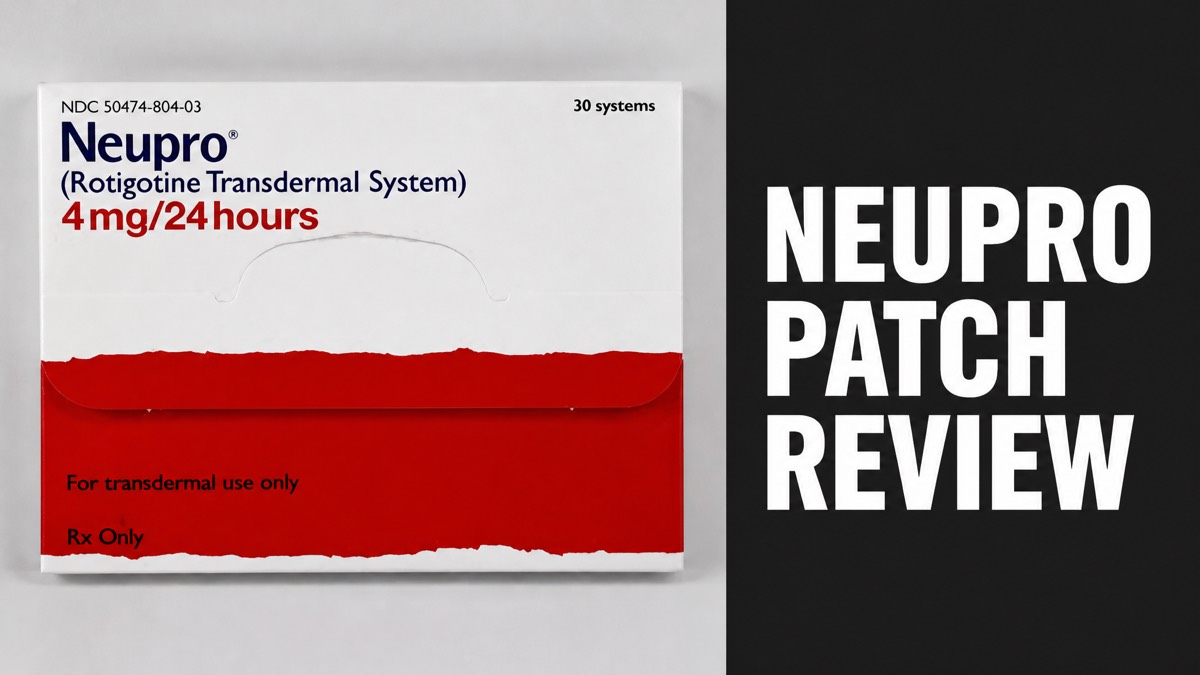
The Neupro patch is a prescription skin patch that delivers the dopamine agonist rotigotine over 24 hours. Doctors prescribe it for Parkinson's disease and moderate-to-severe restless legs syndrome. The FDA first approved Neupro in 2007, and no generic version exists today. Each patch wears for one full day.
Controlled trials show the patch improves motor symptoms and RLS scores. Users rate it 7.6 out of 10 on average. Skin reactions hit up to 43 percent of patients at top doses. Sleep attacks, hallucinations, and augmentation also appear in the warnings. A month of patches costs roughly $725 to $1,028 without coverage. Sulfite allergy rules some patients out.
Neupro offers steady relief to the right patient, but price and skin reactions weigh on the decision. The sections below cover how the patch works, what users say, how oral pills compare, and who needs to avoid it. Read on to see whether the patch fits.
What Is the Neupro Patch?
The Neupro patch is a prescription skin patch that delivers the dopamine agonist rotigotine over 24 hours. Neupro is the brand name. Rotigotine is the generic name of the active drug, and no generic patch exists today.
Each patch is thin and flexible. Six strengths exist, from 1 mg per 24 hours up to 8 mg per 24 hours. The patch grows with the dose. Area runs from 5 square centimeters (0.8 square inches) to 40 square centimeters (6.2 square inches).
Rotigotine belongs to the dopaminergic antiparkinsonism class. The drug mimics dopamine, a chemical that runs low in the brains of people with Parkinson's disease. Here's why that matters: the shared action explains how one patch can treat two different movement conditions.
What Conditions Does Neupro Treat?
Neupro treats Parkinson's disease and moderate-to-severe primary restless legs syndrome. In Parkinson's disease, the patch targets stiffness, tremors, muscle spasms, and poor muscle control. In restless legs syndrome (RLS), the patch targets the urge to move the legs.
Doses differ by condition. Early-stage Parkinson's disease starts at 2 mg and tops out at 6 mg per 24 hours. Advanced-stage disease starts at 4 mg and tops out at 8 mg. RLS starts at 1 mg and tops out at 3 mg.
To be clear, doctors raise the dose weekly. Parkinson's patients move up in 2 mg steps, and RLS patients move up in 1 mg steps. The lowest effective Parkinson's dose is 4 mg, while the lowest effective RLS dose is 1 mg.
Dosing by Condition:
| Condition | Starting Dose | Maximum Dose | Weekly Step |
|---|---|---|---|
| Early-stage Parkinson's disease | 2 mg/24 hours | 6 mg/24 hours | 2 mg |
| Advanced-stage Parkinson's disease | 4 mg/24 hours | 8 mg/24 hours | 2 mg |
| Restless legs syndrome | 1 mg/24 hours | 3 mg/24 hours | 1 mg |
How Does the Neupro Patch Work?
The patch stimulates dopamine receptors in the brain, mainly in the caudate-putamen region. Rotigotine is a non-ergoline dopamine agonist. The exact mechanism for Parkinson's disease and RLS remains unknown, but receptor stimulation is the accepted explanation.
The skin delivers the drug at a steady rate. About 45 percent of the rotigotine leaves the patch within 24 hours. And blood levels show no sharp peak. Why does that matter? Because it gives smooth coverage instead of the highs and lows of pills.
Timing matters. Rotigotine doesn't show up in the blood right away, because a lag of roughly 3 hours comes first. Levels usually peak between 15 and 18 hours after application. After removal, the terminal half-life is 5 to 7 hours.
What Is in the Neupro Patch?
The patch contains three layers: a backing film, a drug matrix, and a protective liner. The backing is aluminized polyester. The matrix holds the rotigotine. The liner peels away just before application.
The matrix carries five inactive ingredients. These are ascorbyl palmitate, povidone, silicone adhesive, sodium metabisulfite, and dl-alpha-tocopherol. The 1 mg patch holds 2.25 mg of rotigotine, and the 8 mg patch holds 18 mg.
Inactive Ingredients:
- Ascorbyl palmitate
- Povidone
- Silicone adhesive
- Sodium metabisulfite
- dl-alpha-tocopherol
Now, two ingredients need attention. Sodium metabisulfite is a sulfite, and sulfites trigger severe allergic reactions in sensitive people. Asthma raises that risk. The aluminum backing can burn the skin during an MRI or cardioversion.
Does the Neupro Patch Actually Work?
Yes. Controlled trials show the Neupro patch improves motor symptoms in Parkinson's disease. In an early-stage trial, patients on up to 6 mg scored 4.0 points better on the UPDRS scale. Placebo patients scored 1.3 points worse, a gap of 5.3 points.
Effects build slowly. Why? Doctors begin with a low dose and adjust it weekly. Several weeks can pass before a patient reaches the best dose. In plain English: the early weeks don't reflect the final result.
And real users describe the same pattern. Some report better posture and less wearing-off between doses of Sinemet. A few notice a little dyskinesia, but they judge the trade worthwhile.
Does Neupro Help Restless Legs Syndrome?
Yes. Neupro reduced RLS symptoms in two six-month placebo-controlled trials. The program enrolled 1,309 patients with moderate-to-severe RLS and tested doses from 0.5 mg to 3 mg. In the 505-patient US trial, the 2 mg and 3 mg groups beat placebo with statistical significance.
Researchers scored patients on the International RLS Rating Scale. The scale holds 10 items and runs from 0 to 40. Baseline scores sat near 23.5, which is where moderate-to-severe disease lands.
But sleep specialists add a caution. The American Academy of Sleep Medicine's 2025 guideline suggests against standard use of transdermal rotigotine for RLS. The guideline still allows the patch for patients who value symptom reduction over long-term risks such as augmentation.
What Do Neupro Patch Reviews Say?
User ratings average 7.6 out of 10 across 74 reviews. Some 68 percent describe a positive experience, and 12 percent describe a negative one. RLS patients rate the patch higher at 8.0 across 49 reviews. Parkinson's patients give 6.8 across 25 reviews.
Positive stories center on speed and sleep. One RLS patient felt relief three hours after the first patch. Another slept through three straight nights after ropinirole stopped working. Several patients call the patch life-changing.
User Ratings by Condition:
| Condition | Average Rating | Reviews |
|---|---|---|
| Restless legs syndrome | 8.0 out of 10 | 49 |
| Parkinson's disease | 6.8 out of 10 | 25 |
| All conditions | 7.6 out of 10 | 74 |
Early effects can feel rough. Some patients report grogginess or heavy daytime sleepiness during the first weeks. Does the feeling last? Not for most, because it fades. One patient adds that relief took time and didn't arrive like magic at first.
What Do Users Complain About?
The top complaint is poor adhesion, since the patch sometimes falls off or lifts at the edges. A few Parkinson's patients wear two patches because one keeps coming loose. Others tape the edges down. Why does that matter? A loose or late patch brings breakthrough symptoms.
Skin trouble comes second, and it's the one patients mention most after sticking problems. Patients describe itchy, red, slightly raised skin where the patch sat. Irritation lasts one to two days and sometimes up to a week. One user feels burning when hot water touches the patch.
Cost and sleep round out the list. One patient lost insurance coverage when the formulary changed and later won manufacturer assistance. Another sleeps poorly on the 8 mg dose. Both still prefer the patch over oral drugs.
Neupro vs Pramipexole and Ropinirole: Which Is Better?
Neither side wins on efficacy, because pramipexole and ropinirole are the closest alternatives with similar results. Both are oral non-ergoline dopamine agonists. A double-blind trial in advanced Parkinson's disease found comparable efficacy between pramipexole and rotigotine.
The real difference is delivery. Why does delivery matter? The patch gives steady 24-hour levels, while ropinirole tablets wear off faster and need several doses per day. Extended-release pills narrow that gap, but plain tablets leave levels swinging.
What's more, price separates them sharply. A month of Neupro costs around $725, while a month of Requip costs around $220. Pill schedules also differ. Requip starts at 0.25 mg three times daily and climbs to 4 mg per day for RLS.
Neupro vs Requip:
| Attribute | Neupro | Requip |
|---|---|---|
| Active drug | Rotigotine | Ropinirole |
| Form | Daily patch | Oral tablet |
| Monthly cost | Around $725 | Around $220 |
| RLS dose range | 1-3 mg/24 hours | Up to 4 mg/day |
Does Neupro Cause Augmentation?
Yes. Neupro can cause augmentation, a worsening of RLS during treatment. Symptoms grow more severe or start earlier in the day than before treatment. Is the patch exempt? No. All dopaminergic RLS drugs carry this risk, and the patch is no exception.
Rebound is a related problem. Rebound is a flare of symptoms at the end of a dose, tied to the drug's half-life. Wearing off or stopping a dopaminergic drug can trigger it.
The good news? Switching drugs is common after augmentation. One patient developed augmentation two weeks into Requip at 3 mg. A sleep study followed, and the doctor moved the patient to a 3 mg Neupro patch. Symptoms eased fast.
What Are the Side Effects of Neupro?
Common side effects include nausea, vomiting, sleepiness, dizziness, and skin reactions at the patch site. In the early Parkinson's trial at 6 mg, other frequent effects were appetite loss, sleep problems, sweating, and visual disturbance. Twelve percent of Neupro patients quit for side effects, against 6 percent on placebo.
By comparison, advanced Parkinson's disease shows a different mix. Skin reactions, nausea, ankle swelling, dizziness, and dyskinesia lead the list. About 15 percent of patients at 8 mg stopped treatment, against 9 percent on placebo.
Pay attention to this: serious warnings exist. Neupro can cause sudden sleep onset during daily activities, hallucinations, and psychotic symptoms. Neupro can also lower blood pressure, cause fainting, and raise heart rate. Weight gain and fluid retention also occur.
Some patients develop unusual urges. Examples include gambling, heavy spending, binge eating, and increased sexual urges. Patients or their families may notice these changes. Anyone who spots them needs to tell the prescribing doctor.
Does the Neupro Patch Irritate Skin?
Yes. Skin reactions at the patch site are among the most common effects. At the top dose, 32 percent of early Parkinson's patients had reactions, against 19 percent on placebo. The figures were 36 percent versus 13 percent in advanced Parkinson's disease, and 43 percent versus 4 percent in RLS.
Prevention starts with rotation. Patients move the patch to a new spot every day. No spot gets reused for 14 days. Is every mark a problem? No. Mild redness, like the mark after a bandage, is normal.
Skin Reaction Rates at the Top Dose:
| Patient Group | Neupro | Placebo |
|---|---|---|
| Early Parkinson's disease | 32% | 19% |
| Advanced Parkinson's disease | 36% | 13% |
| Restless legs syndrome | 43% | 4% |
Some reactions need action, though. Redness that lasts several days, worsens, or spreads past the patch edge needs a doctor. Direct sunlight on irritated skin can change its color. A generalized skin reaction means the patch must stop.
Who Should Avoid the Neupro Patch?
People who are allergic to rotigotine or to sulfites need to avoid the patch. Sulfite allergy differs from sulfa allergy. Who faces the higher risk? People with asthma. Swelling of the lips or tongue, chest pain, or trouble breathing calls for immediate removal of the patch.
Several conditions also need a doctor's review first. These include high or low blood pressure, heart problems, kidney disease, schizophrenia, bipolar disorder, psychosis, narcolepsy, and other sleep disorders. Light-headedness when standing also counts.
Conditions to Discuss First:
- High or low blood pressure
- Heart problems
- Kidney disease
- Schizophrenia, bipolar disorder, or psychosis
- Narcolepsy or another sleep disorder
- Light-headedness when standing up
Other medicines change the picture too. Opioids, sleeping pills, muscle relaxers, and drugs for anxiety or seizures add to drowsiness. Alcohol raises side effects. Dopamine antagonists, such as antipsychotics and some nausea drugs, work against the patch.
Pregnancy and breastfeeding carry open questions as well. Harm to an unborn baby is unknown, so patients tell their doctor about pregnancy plans. Breastfeeding is not advised during treatment. Parkinson's patients also face a higher melanoma risk and need skin checks.
Is Neupro FDA Approved and Safe?
Yes. The FDA approved Neupro in 2007, and the patch is legitimate prescription medicine. Safety, however, depends on the patient. Heart-rhythm testing found no QT prolongation at doses up to 24 mg per 24 hours.
But the risk list is real. Sudden sleep attacks, hallucinations, low blood pressure, and compulsive behaviors all appear in the warnings. Patients avoid driving until they know how the patch affects them.
How Do You Use the Neupro Patch?
Use starts with pressing a fresh patch onto clean, dry, hairless skin for 30 seconds. Approved sites are the stomach, thigh, hip, flank, shoulder, and upper arm. Patients avoid skin with lotion, oil, cream, ointment, or powder.
So, the patch stays on for 24 hours. Patients change it at the same time every day. Each new patch goes on a different spot, and no area gets reused within 14 days. Washing hands afterward is part of the routine.
Steps:
- Choose clean, dry, hairless skin that holds no lotion, oil, or powder.
- Remove the patch from its sealed pouch and peel off the liner.
- Press the patch firmly in place for 30 seconds.
- Wear the patch for 24 hours, then replace it at the same time on a new spot.
Heat is the main hazard. Why? Heating pads, electric blankets, saunas, hot tubs, heated water beds, and direct sunlight push too much drug through the skin. Showers and swimming are fine. Hot baths are not.
Stopping needs a plan. Patients never quit suddenly, and that's important. Doctors cut Parkinson's doses by no more than 2 mg every other day. RLS doses drop by no more than 1 mg every other day. Patches also come off before any MRI.
What if a Neupro Patch Falls Off?
A fallen patch gets replaced right away with a fresh patch on a different spot. Patients wear the new patch for the rest of the day. The next change happens at the usual time the following day. Bandaging tape can hold lifted edges.
A forgotten change follows the same logic. Patients apply a new patch as soon as they remember. The regular schedule stays the same, even when the new patch wears for less than 24 hours.
How Much Does the Neupro Patch Cost?
A 30-patch box costs between roughly $818 and $1,028 without insurance. A discount card brings one listing down to $795.26. Another price tracker shows $28.43 per 6 mg patch, which equals about $853 for 30 patches.
The good news? Help exists. Eligible commercial patients may pay as little as $10 for a 30-day supply through the manufacturer's savings program. A patient assistance program can provide the drug at no cost to eligible patients. Medicare Part D plans often cover it.
No generic is available, so price competition is limited. So why does cost show up so often in patient stories? Oral alternatives cost far less, and that gap is hard to miss.
Where Can You Buy Neupro?
Neupro requires a doctor's prescription and sells at major pharmacies such as CVS and Walgreens. Discount cards and coupons work at thousands of pharmacies. The manufacturer's savings card applies to eligible commercial plans.
Some patients start with a doctor's sample pack. Each patch stays sealed in its pouch until use. Pouches belong at room temperature, away from heat and moisture.
Is the Neupro Patch Worth It?
Yes. For the right patient, the patch delivers real symptom control that justifies its cost. Trials back the benefit, and user ratings run positive. Steady 24-hour delivery also removes pill timing from daily life.
The downsides are plain, though. The price is high. Skin reactions hit roughly a third to nearly half of patients at top doses. Sleep attacks and hallucinations are real risks. RLS patients also face augmentation.
Pros:
- Steady 24-hour drug delivery
- Trial-backed symptom improvement
- No pill timing
- Positive user ratings
Cons:
- High price with no generic
- Frequent skin reactions
- Sleep attacks and hallucinations
- Augmentation risk in RLS
Bottom line: it's a qualified yes. Patients who tolerate the adhesive and manage the cost gain a dependable option. Patients with a sulfite allergy or a psychosis history need a different treatment.
Who Is Neupro Best For?
Neupro fits people with Parkinson's disease or moderate-to-severe RLS who need steady coverage. Patients who struggle with pill schedules or wear off between doses benefit most. Patients whose oral drugs stopped working also gain a second option.
Poor candidates, by contrast, are easy to name. Sulfite allergy, strong adhesive sensitivity, or a history of hallucinations makes the patch a weak choice. Doctors weigh each case before prescribing.
Coffee Loving Card Makers is a reader-supported platform. Purchases made through our links may earn us an affiliate commission at no extra cost to you. Learn more.