
Lidoderm Patch Review: Does the 5% Lidocaine Patch Work?
 By Anna Krause November 4, 2026
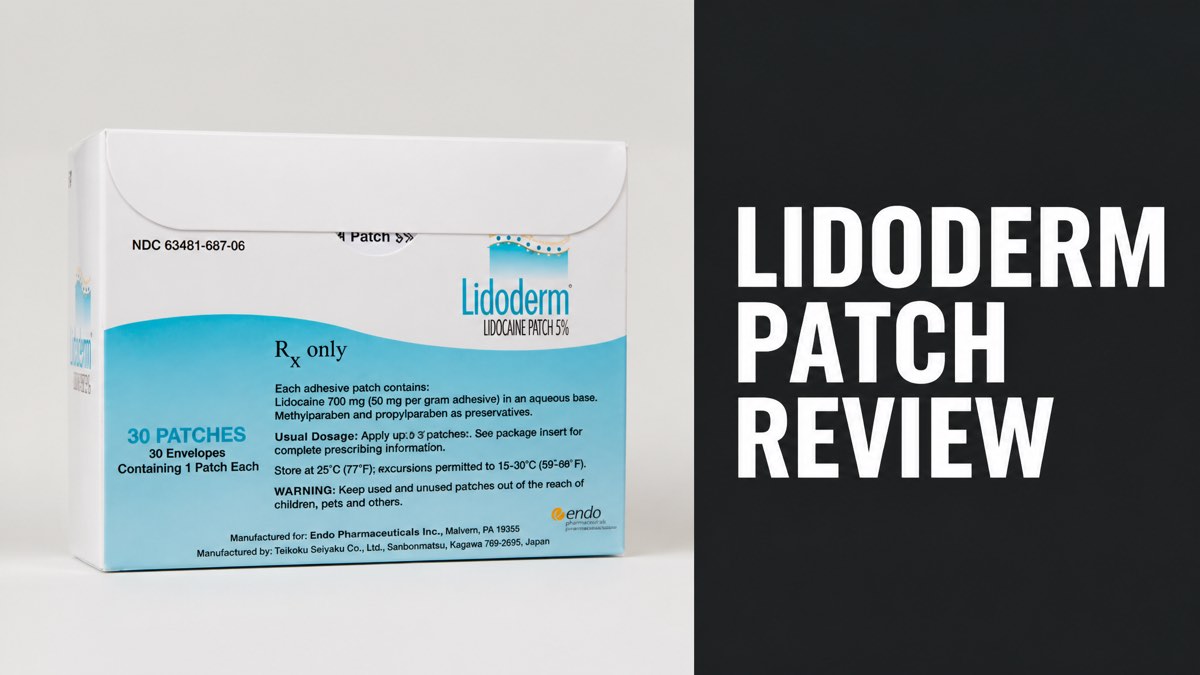
Lidoderm patch is a prescription lidocaine 5% patch that numbs the skin over painful nerves. The FDA approved it in 1999 for nerve pain after shingles. Each patch carries 700 mg of lidocaine. Doctors also prescribe it for back, hip, and rib pain, and Endo Pharmaceuticals markets the brand in the United States.
User ratings sit in the middle. Averages run from 3.8 out of 5 to 4.2 out of 10, and positive shares range from 30% to 74%. Praise centers on relief without opioids. Complaints center on adhesion, brand swaps, and cost. Lidoderm holds the highest strength among lidocaine patches at 5%. Safety data shows minimal absorption and mostly mild skin reactions.
The sections below cover how the patch works, what is inside, its side effects, and how it compares with ZTlido and over-the-counter patches. Cost, where to buy, and who must avoid the patch follow. By the end, readers will know whether the price and the adhesion risk are worth the relief.
What Is Lidoderm Patch?
Lidoderm patch is a prescription lidocaine 5% patch that relieves nerve pain after shingles. The FDA approved the brand on March 19, 1999. Doctors prescribe it for postherpetic neuralgia, the burning pain that lingers after a shingles infection.
The patch belongs to a drug class called local anesthetics. Each adhesive patch carries 700 mg of lidocaine. The medication is not a controlled substance, and pharmacies fill it by prescription only.
Doctors also prescribe the patch off-label for other localized pain. Users report trying it on the back, ribs, hips, and wrists. Those uses fall outside the approved label.
Who Makes Lidoderm Patch?
Endo Pharmaceuticals markets Lidoderm patch in the United States. Teikoku Seiyaku in Japan manufactures the patch itself. The box lists both companies.
Endo agreed to pay $171.9 million to settle False Claims allegations over off-label marketing of the patch. The settlement concerns how the company promoted the product. The settlement does not change the patch's FDA-approved use.
Other companies sell generic 5% lidocaine patches. Users name Watson, Mylan, and Qualitest as makers. Adhesion and flexibility differ between those brands.
How Does Lidoderm Patch Work?
Lidoderm patch numbs the skin area where the patch sits. Lidocaine blocks pain signals from the nerves in the skin. Those signals never reach the brain. So why does the rest of the body feel nothing? Because absorption into the bloodstream stays minimal.
To be clear, relief stays local. The rest of the body stays unaffected.
Users apply the patch to the painful area once a day. The label allows up to 12 hours of wear in a 24-hour period, with up to 3 patches at once. Many users follow a 12-hours-on, 12-hours-off routine. Why that split? The label allows only 12 hours of wear in a 24-hour period.
Here's the part most people want to know: relief builds within about an hour. One user reports being 95% pain free after 30 minutes. Others notice pain returning a few hours before the next patch goes on.
What Is in Lidoderm Patch?
Each patch contains 700 mg of lidocaine, which equals 50 mg per gram of adhesive. The adhesive sits in an aqueous base. Lidocaine is the only active ingredient.
The adhesive layer rests on a non-woven polyester felt backing. A polyethylene terephthalate film covers the adhesive until application. Users peel the liner off before placing the patch.
Methylparaben and propylparaben act as preservatives. Each patch arrives in its own envelope, and a box holds 30 envelopes.
What Are the Benefits of Lidoderm Patch?
Lidoderm patch delivers localized, non-opioid pain relief. Several users choose the patch because they refuse opioids. Why does that matter? The patch numbs one area and involves no narcotic. Others can't take oral pain medicine because it upsets the stomach.
The numbing action targets one area. Users place patches only where the pain sits, such as the ribs, the lower back, or a wrist.
Long wear does not appear to dull normal touch. Extended application does not cause A-beta-mediated sensory loss at the application site. That finding matters for patients who already have some sensory loss. Why? Because normal touch stays intact under the patch.
Main Benefits:
- Targeted numbing of the painful area
- No opioid involved
- Minimal absorption into the bloodstream
- No drug interactions noted in clinical trials
- Up to 12 hours of wear per day
Does Lidoderm Patch Relieve Shingles Nerve Pain?
Yes. Lidoderm patch holds FDA approval for postherpetic neuralgia, which is its approved use. Clinical literature calls its safety and efficacy well established for that condition.
User results run mixed. Ratings for topical lidocaine products on postherpetic neuralgia average 2.2 out of 10 across 30 reviews. Some users report relief from the sharp burning, while others report none.
Location matters. One user with pain along the trigeminal nerve near the eye reports poor adhesion and no relief. Hair and facial contours make patches hard to place.
Does Lidoderm Patch Help Back Pain?
Yes. For some users the patch eases back pain, though the FDA has not approved it for that use. Users with lumbar disc disease, spondylosis, and spinal injuries report steady relief.
One user with chronic lower back pain describes the pain dropping to about half its former level. Another with severe spine degeneration says the patch lets that user function each day. In plain English: the patch turns a bad day into a workable one for some people.
Results vary by body area. One user reports relief only on the ribs, not on the back or hips. Patch placement and fit appear to matter.
What Do Lidoderm Patch Reviews Say?
Lidoderm patch ratings land in the middle of the scale. One set of 173 reviews averages 3.8 out of 5, and about 74% report a positive effect. Another set of 91 reviews averages 4.2 out of 10.
In that second set, 30% of reviewers report a positive experience and 58% report a negative one. A smaller set of 60 ratings averages 4.0 out of 5. The scales differ. So what does that mean? The overall picture is mixed.
Rating Summary:
| Sample | Average Rating | Positive Share |
|---|---|---|
| 173 reviews | 3.8 out of 5 | About 74% |
| 91 reviews | 4.2 out of 10 | 30% (58% negative) |
| 60 ratings | 4.0 out of 5 | Not reported |
What Are the Positive Experiences?
Positive experiences center on daily function and non-opioid relief. Users with chronic back, hip, and spine pain say the patch lets them move through the day.
Speed earns praise, and here's why: users want relief fast. One user with 13 years of lower back pain reports being 95% pain free 30 minutes after application. Another feels major relief in about an hour.
Work rules shape some choices. A heavy vehicle driver uses the patch with over-the-counter pain medicine because an employer drug policy limits other drugs.
What Are the Common Complaints?
The loudest complaints target adhesion, brand swaps, and price. Edges curl as the patch goes on. Some patches fold, stick to themselves, or fall off within hours.
The maker matters. Users praise patches from Endo and Watson. Users call patches from Mylan useless because the backing is stiff and does not move with the body.
The bad news? Money adds frustration. Users call the patches very expensive, and one user on Medicare pays full price because coverage for spinal problems is refused.
Top Complaints:
- Edges curl during application
- Patches fold and stick together
- Patches fall off within hours
- High out-of-pocket cost
- Insurance coverage denials
How Does Lidoderm Patch Compare to Other Lidocaine Patches?
Lidoderm patch competes with ZTlido and over-the-counter 4% lidocaine patches. Lidoderm holds the highest strength at 5%. ZTlido contains 1.8% lidocaine.
ZTlido earns mixed feedback. One user reports good adhesion but no pain relief. Another reports insurance fights and pharmacies that never keep the patch in stock.
Lidocaine Patch Options:
| Patch | Strength | Access |
|---|---|---|
| Lidoderm | 5% | Prescription |
| ZTlido | 1.8% | Prescription |
| Salonpas lidocaine | 4% | Over the counter |
| Aspercreme lidocaine | 4% | Over the counter |
When Does an Over-the-Counter Patch Make Sense?
An over-the-counter patch makes sense for mild, localized pain and a first trial. The 4% patches need no prescription. Buyers skip the doctor visit and the pharmacy queue.
By comparison, Lidoderm carries 5% lidocaine and requires a prescription. That route puts a doctor in charge of diagnosing nerve pain such as postherpetic neuralgia.
No evidence compares the strengths head to head. The choice rests on a doctor's advice, the pain type, and the budget.
Is Lidoderm Patch Safe?
Yes. Lidoderm patch carries a low systemic risk for most users. Absorption stays minimal, even with continuous use of up to four patches per day.
Clinical trials noted no drug-drug interactions. The FDA approved the brand in 1999, and the patch stays prescription only. The drug is not a controlled substance.
Storage matters. Keep used and unused patches out of reach of children, pets, and others. Store the box at 25°C (77°F), with brief excursions to 15-30°C (59-86°F) allowed.
What Are the Side Effects of Lidoderm Patch?
Skin reactions are the most common side effect. Temporary irritation, redness, and a mild burning feeling appear where the patch sits. Those effects often fade as the body adjusts.
Headache also appears on the list. Blurred vision and redness in the whites of the eyes call for a doctor's check. A few users report lightheadedness or stomach upset, and one reports blacking out during daytime use.
The good news? Many users report no side effects at all. One user who wore the patch for years describes none.
Reported Side Effects:
- Skin irritation
- Redness at the application site
- Mild burning feeling
- Headache
- Blurred vision (report to a doctor)
Who Should Avoid Lidoderm Patch?
People with a known allergy to lidocaine or similar numbing drugs are poor candidates for the patch. A doctor confirms that history before prescribing.
Households with young children or pets need careful storage. Used patches still hold medicine. Why store them carefully? The label warns to keep them out of reach.
A doctor decides whether the patch fits people with other conditions. The available evidence names no further groups.
How Much Does Lidoderm Patch Cost?
Lidoderm patch costs more than most users expect. Users call the patches very expensive. An older price listing put a single patch near $27.
Generics offer limited relief on cost. The drug-facts listing notes no lower-cost generic. Users still compare makers for adhesion rather than price.
Coverage varies. One user on Medicare pays full price because spinal problems go uncovered. Another watched Medicare switch to a different maker. Why does that matter? Because the new patch did not stick the same way.
Is Lidoderm Patch Worth the Price?
Yes. Lidoderm patch is worth the price for users who get steady relief and good adhesion. Users with spine disease who regain daily function call the cost acceptable.
One user refuses opioids and pays full price for what that user calls tremendous relief. The alternative to the patch is a drug that user will not take.
A patch that falls off within hours wastes money. So maker choice shapes the value.
Where to Buy Lidoderm Patch?
Pharmacies fill Lidoderm patch by prescription only. A doctor writes the prescription, and the pharmacy dispenses the box of 30 patches.
The maker can change between fills. Insurers have sent patches from Mylan, and Medicare once switched one user to a patch from Actavis. Users notice the difference in adhesion at once. Why? Adhesion differs by maker.
Prescription discount services list coupons for the 5% patch. A coupon lowers the price at the counter for buyers without coverage.
Is Lidoderm Patch Worth It?
Yes. Lidoderm patch is worth it for the right user. People with localized nerve pain, especially after shingles, get FDA-approved relief with low systemic risk and no opioid.
Short answer: yes, with caveats. The drawbacks are real. The price runs high, adhesion varies by maker, and ratings stay mixed. And a poor patch can fall off within hours.
Pros:
- FDA-approved for postherpetic neuralgia
- Localized numbing with minimal absorption
- No opioid involved
Cons:
- High cost and coverage gaps
- Adhesion varies by maker
- Mixed ratings across users
Who Is Lidoderm Patch Best For?
Lidoderm patch suits people with localized nerve pain. Postherpetic neuralgia is the clearest fit, and users with back, rib, and hip pain report relief too.
People who avoid opioids gain the most. The patch numbs one area and leaves the rest of the body alone.
Widespread pain fits less well. A patch covers only the skin under it.
Coffee Loving Card Makers is a reader-supported platform. Purchases made through our links may earn us an affiliate commission at no extra cost to you. Learn more.