
Further Food Collagen Review: Is It Worth It?
 By Anna Krause October 5, 2026
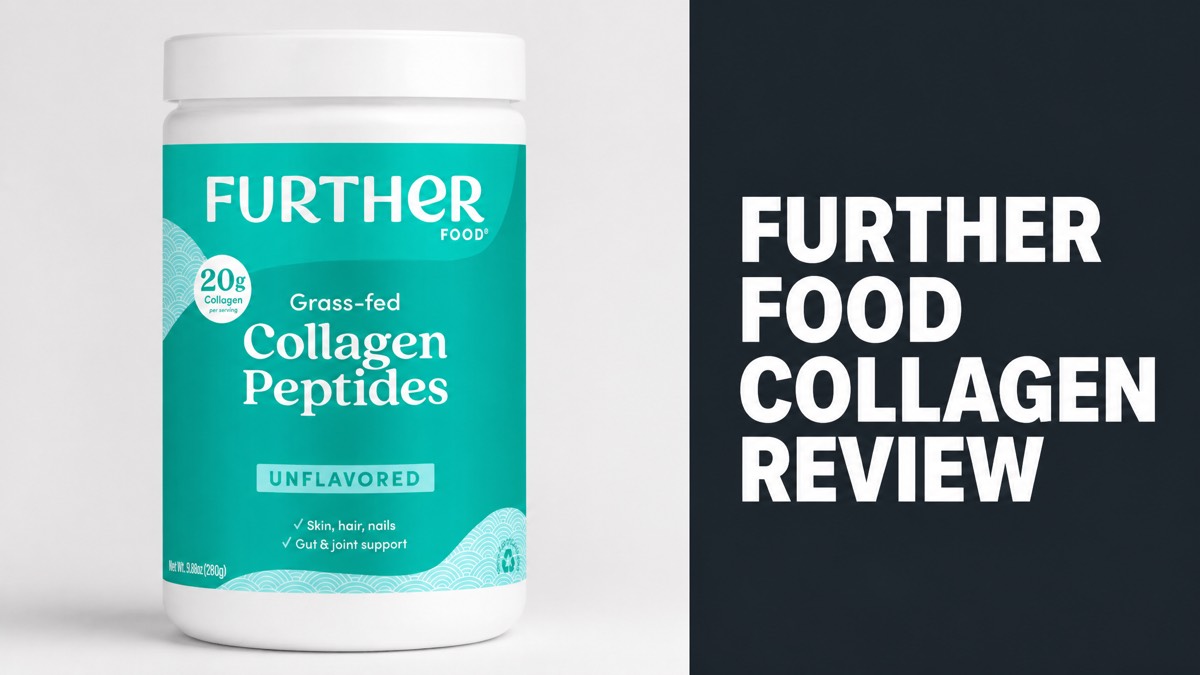
Further Food Collagen Peptides is a powdered supplement made from grass-fed, pasture-raised bovine hide collagen. The US brand sells it unflavored or in flavors like chocolate and matcha. A marine version covers buyers who skip bovine sources. One scoop stirs into coffee, tea or smoothies.
The unflavored powder holds a single ingredient and a 20 g (0.7 oz) scoop. Buyers praise the neutral taste, easy mixing and heavy metal testing. Skin, hair and joint benefits come from personal experience, not trials. No side effects are known at the 20 g serving, and vegans need to look elsewhere. Price and canister size draw the sharpest complaints.
Rising prices, smaller canisters and a few mixing complaints complicate the picture. A comparison with Vital Proteins and a look at the marine option follow. Read on to see what the powder costs, where to buy it, which side effects matter and which buyers get the most from it.
What Is Further Food Collagen?
Further Food Collagen Peptides is a powdered collagen supplement made from grass-fed, pasture-raised bovine hide collagen. The unflavored version anchors the line. Further Food manufactures and packages its products in the USA.
The brand builds its identity on one idea: food is the best medicine. And its facilities hold cGMP certification. Every canister carries that US-made, quality-first pitch.
The collagen range spans canisters and stick packs. Flavors include chocolate, vanilla, matcha, pumpkin spice and hazelnut. A separate marine collagen covers buyers who skip bovine sources.
What Is in Further Food Collagen?
Unflavored Further Food Collagen Peptides contains one ingredient: hydrolyzed bovine collagen. Where's the sugar? There isn't any, and there are no sweeteners either. The brand labels it keto and paleo friendly.
The collagen supplies Type 1 and Type 3 collagen. In fact, the brand names glycine, proline and hydroxyproline as the key amino acids. Those amino acids act as building blocks for skin, tendons and connective tissue.
For context, an older label lists an 8 g (0.28 oz) serving with 7 g of protein and 30 calories. Sodium sits at 25 mg and sugar at 0 g. A 32 oz (907 g) bag of that version held about 113 servings.
Flavored versions add functional ingredients. For example, chocolate pairs with reishi mushroom. Vanilla adds tremella mushroom. Matcha adds cordyceps. Pumpkin spice and hazelnut complete the range.
Flavor choice shows up in the ratings, too. Unflavored scores 4.6 out of 5 across 745 ratings. Chocolate matches at 4.6 across 167. Vanilla holds 4.4 across 1,353, matcha 4.3 across 695, and pumpkin spice 3.8 across 52.
Rating by Flavor:
| Flavor | Rating | Ratings |
|---|---|---|
| Unflavored | 4.6 out of 5 | 745 |
| Chocolate | 4.6 out of 5 | 167 |
| Vanilla | 4.4 out of 5 | 1,353 |
| Matcha | 4.3 out of 5 | 695 |
| Pumpkin spice | 3.8 out of 5 | 52 |
How Does Further Food Collagen Work?
Further Food Collagen delivers hydrolyzed collagen peptides, which the body absorbs more easily than intact collagen. Collagen is a structural protein found in skin, bones, hair and nails. In other words, small peptides make each scoop easier to digest.
Collagen powder is not the same as protein powder. The amino acids glycine, proline and hydroxyproline form the building blocks of skin, tendons, ligaments and connective tissue. So what does a scoop actually supply? Those amino acids, in one dose.
The brand also claims collagen satisfies hunger more than whey, soy or casein. To be clear, that satiety claim comes from the brand itself. Satiety counts as a possible extra, not a proven result.
How Do You Take Further Food Collagen?
One daily scoop of 20 g (0.7 oz) delivers the full serving. The brand once suggested one to two scoops a day, around 15 to 20 g (0.5 to 0.7 oz) in total. So what changed? The larger scoop replaced that advice, and the brand says consistency matters most.
The powder stirs into coffee, tea, protein shakes, lemon water and yogurt. Pro tip: a blender gives the smoothest result. One buyer adds a scoop to a Vitamix smoothie and gets a creamy texture.
Easy Mix-Ins:
- Coffee
- Tea
- Protein shakes
- Lemon water
- Yogurt
- Smoothies
Here's the one habit the brand advises: take collagen with food to prevent any intestinal discomfort that may occur.
What Are the Benefits of Further Food Collagen?
Further Food Collagen targets skin, hair, nails, bones, joints and gut health. The brand markets one 20 g (0.7 oz) scoop as the dose for glowing skin, stronger nails and hair, and a healthier gut. To put it simply: these are marketing claims, not proven outcomes.
The brand says the larger scoop delivers quicker results than the old serving. But the brand also stresses that consistency decides the outcome, so one scoop must happen daily.
Katey Davidson, a registered dietitian, notes that an older scoop gave 7 g of protein. That's because collagen powder differs from protein powder, so protein totals stay modest.
Does Further Food Collagen Help Skin, Hair, and Nails?
Yes. Many buyers report visible skin, hair and nail changes within weeks. One buyer saw better skin after thirty days at one scoop per day in coffee. Another noticed fewer big bruises on the arms.
And hair and nails earn the same praise. Buyers describe faster hair growth and longer nails. One buyer adds improved digestion, and that buyer's daughter stirs it into yogurt and reports amazing results.
Individual experiences are not controlled trials. So does the FDA back the claims? No. The product carries the standard supplement notice that its statements are not evaluated by the FDA. Skin results vary from buyer to buyer.
Does Further Food Collagen Help Joints?
Yes. For some buyers, joint comfort improves with daily use. A gym-goer reports far less joint pain during workouts after adding it to coffee. Pain still returns now and then, but far less than before.
And long-term users echo that story. One buyer has used it since 2020. Another buyer's mother notices a significant joint difference whenever the canister runs out.
Results aren't universal. What happens when joints don't respond? One buyer saw no change in arthritic joints after a month and planned a second month. Joint results take patience, and some buyers see none.
What's more, the marine version adds Type 2 collagen, which the brand ties to joint support. Buyers focused on joints can compare the marine version with the bovine one.
What Do Further Food Collagen Reviews Say?
Further Food Collagen reviews score high, with 4.6 out of 5 for the unflavored 9.88 oz (280 g) canister. That average spans 745 ratings. The canister ranks #150 among collagen supplements.
The brand claims more than 10,000 five-star reviews across all its products. Praise clusters around taste and mixing. Complaints cluster around price and canister size.
The split paints a clear picture. So where does the friction come from? Buyers love the powder itself, and they grumble about what it costs.
What Do Buyers Like?
Buyers like the neutral taste and lack of smell most. Many say the powder vanishes into coffee, smoothies and protein shakes. One buyer prefers it to the cow smell that other brands carry.
The powder dissolves well, too. A Vitamix smoothie comes out creamy. The container never clumps, and the powder stays loose from first scoop to last.
Top Praise:
- Neutral taste
- No smell in most drinks
- Dissolves well
- Creamy in a blender
- No clumping in the container
Katey Davidson, a registered dietitian, calls it a simple, decent collagen powder. She praises the short ingredient list, the hydrolyzed peptides and the third-party testing. But she also notes that cheaper options exist.
What Do Buyers Complain About?
Buyers complain most about price and canister size. Why does that sting? One buyer watched the price climb from $19 to $23 while the canister shrank. Another says the product costs more than Vital Proteins and holds less.
Mixing draws some criticism, too. One buyer sees a film on the cup and its sides in coffee. Another smells the powder in boiling water with plain black tea. A third notes that coffee turns slightly thicker.
The chocolate version earns an even harsher verdict from one buyer. The powder feels fluffy instead of dense, and the taste reads bland. That buyer plans no reorder unless the price drops.
Common Complaints:
- Price rise from $19 to $23
- Smaller canister
- Film on the cup in coffee
- Smell in boiling tea
- Bland chocolate flavor
- Plastic scoop in every jar
One buyer asks for a no-scoop option on subscriptions to cut plastic waste. Subscribers can reuse a single scoop across jars.
How Does Further Food Collagen Compare to Vital Proteins?
Further Food Collagen now matches Vital Proteins on dose at 20 g (0.7 oz) of collagen per serving. The older Further Food scoop held only 6.6 g (0.23 oz), so the larger scoop closed the gap. Both brands source grass-fed bovine collagen.
Price decides most comparisons. What does Vital Proteins cost? About $40 for 28 servings, or $1.42 each. Further Food listed $24.99 for 28 servings in 2023, but that price covered the smaller scoop, so per-gram value needs a fresh calculation.
At the same time, both brands cite testing. Vital Proteins cites NSF and cGMP standards. Further Food cites third-party heavy metal testing and cGMP facilities.
Further Food vs Vital Proteins:
| Feature | Further Food | Vital Proteins |
|---|---|---|
| Collagen per serving | 20 g (0.7 oz) | 20 g (0.7 oz) |
| Source | Grass-fed, pasture-raised bovine | Grass-fed, pasture-raised bovine |
| Testing | Third-party heavy metals, cGMP | NSF, cGMP |
| Price | $24.99 for 28 servings (2023, smaller scoop) | About $40 for 28 servings ($1.42 each) |
One Vital Proteins loyalist tried Further Food and went back. The buyer found it pricier, less dense and lower in collagen per scoop. The verdict? No reorder unless the price drops significantly.
Bovine or Marine: Which Further Food Collagen Fits?
Further Food Premium Marine Collagen comes from wild-caught codfish and suits pescatarians. The marine powder contains Type 1, 2 and 3 collagen. The marine powder also works for anyone who avoids bovine sources.
Marine collagen costs about $0.18 per gram. The canister holds 5.93 oz (168 g) and 28 servings. Stirred with a fork into 6 oz (180 ml) of water, the powder leaves small clumps and froths almost like a latte.
Very Well Health named Further Food Premium Marine Collagen its best marine collagen. And that recognition makes the marine version the stronger pick for buyers who avoid bovine sources.
What Are the Side Effects of Further Food Collagen?
Further Food Collagen has no known side effects reported at the 20 g (0.7 oz) serving. The brand states that buyers who tolerated the earlier, smaller dose will typically tolerate the larger one. The unflavored formula contains a single ingredient.
Digestive comfort calls for one habit. The brand recommends taking collagen with food to prevent any intestinal discomfort. Anyone adding a new supplement can start there.
Regulation matters here. To be clear, dietary supplement statements are not evaluated by the FDA. The product does not diagnose, treat, cure or prevent any disease.
Who Should Avoid Further Food Collagen?
Vegans and vegetarians fall outside the collagen line's audience. Collagen comes from bovine hide or fish. The brand lists its vegan products separately from the collagen range.
Allergen-sensitive buyers face a caveat. The products contain no gluten, dairy or nut ingredients. Does that make them allergen-safe? No. The facilities aren't verified gluten-free, dairy-free or nut-free, so cross-contact stays possible.
And buyers with a medical condition, pregnant buyers and nursing buyers need a healthcare provider's approval first. Fish allergies rule out the marine version.
Is Further Food Collagen Legit?
Yes. Further Food operates as an established brand with a US manufacturing base. Products come from cGMP certified facilities in the USA. Buyers report using the collagen since 2020 and reordering for years.
The retail footprint backs that up. The collagen sits in the brand's own store and at Costco, Walmart, iHerb, Vitacost and Amazon. Costco lists it as kosher, non-GMO, sugar free, dairy free and gluten free.
Legit doesn't mean medically proven. Benefit claims follow normal supplement rules and carry no FDA evaluation. Buyers judge results by their own experience.
Is Further Food Collagen Third-Party Tested?
Yes. Further Food states that its products undergo extensive third-party testing for heavy metals. The facilities hold cGMP certification. No lab name appears in that statement.
Katey Davidson, a registered dietitian, counts the third-party testing as a clear plus. The testing backs her verdict of a simple, decent powder.
The product comparison chart marks every Further Food product as purity tested. Buyers who want the actual lab results need to contact the brand.
How Much Does Further Food Collagen Cost?
Further Food Collagen costs roughly $20 to $30 per canister. The brand homepage shows a $25.00 sale price against a $30.00 regular price on one item. One buyer watched a canister rise from $19 to $23.
Now, shipping inside the US costs $6.99 on orders under $59. Orders of $59 and up ship free. Express shipping runs $13.99 for delivery in 2 to 3 business days.
US Shipping Costs:
| Order | Cost |
|---|---|
| Under $59 | $6.99 |
| $59 and up | Free |
| Express, 2 to 3 business days | $13.99 |
The good news? Subscribe and Save takes 20% off. Shop Pay splits orders over $50 into four biweekly payments with 0% interest. Both options cut the upfront cost.
A 30-day money-back guarantee backs every purchase. Is that the whole story? Not quite. The returns policy page asks for notice within 15 days instead, so buyers who want the longer window need to confirm it with the brand before ordering.
Where Can You Buy Further Food Collagen?
Further Food Collagen sells through the brand's own store and major retailers. Amazon, Costco, Walmart, iHerb and Vitacost all carry it. Costco offers a 32 oz (907 g) bag with 113 servings, limited to 5 per member.
The brand ships across the US and Canada. Buyers elsewhere order through iHerb, which carries most Further Food products.
Is Further Food Collagen Worth It?
Yes. Short answer: Further Food Collagen earns a qualified recommendation as a simple, clean collagen powder. The single ingredient, hydrolyzed peptides, neutral taste, heavy metal testing and 4.6 rating all count as strengths.
The weaknesses are real, though. Prices rose while canisters shrank, some coffee drinkers see a film on the cup, and skin, hair and joint benefits rest on personal experience, not trials.
Bottom line: it's a solid, simple collagen powder, and cheaper options exist. Buyers who value taste and testing over price get good value. Budget shoppers have alternatives.
Pros:
- Single ingredient
- Hydrolyzed peptides
- Neutral taste
- Heavy metal testing
- 4.6 rating on the unflavored canister
Cons:
- Price rise
- Smaller canisters
- Film on the cup in some coffee
- Benefits rest on personal experience
Who Should Buy Further Food Collagen?
Coffee and smoothie drinkers fit this powder best. The unflavored collagen vanishes into drinks without taste or smell for most buyers. A single-ingredient label suits buyers who like short ingredient lists.
On the flip side, budget shoppers, vegans and buyers who demand proven joint results fit poorly. Price, animal sourcing and anecdotal evidence all work against those buyers.
Coffee Loving Card Makers is a reader-supported platform. Purchases made through our links may earn us an affiliate commission at no extra cost to you. Learn more.