
Four Leaf Rover Collagen Review: Is It Worth It for Your Dog?
 By Anna Krause October 4, 2026
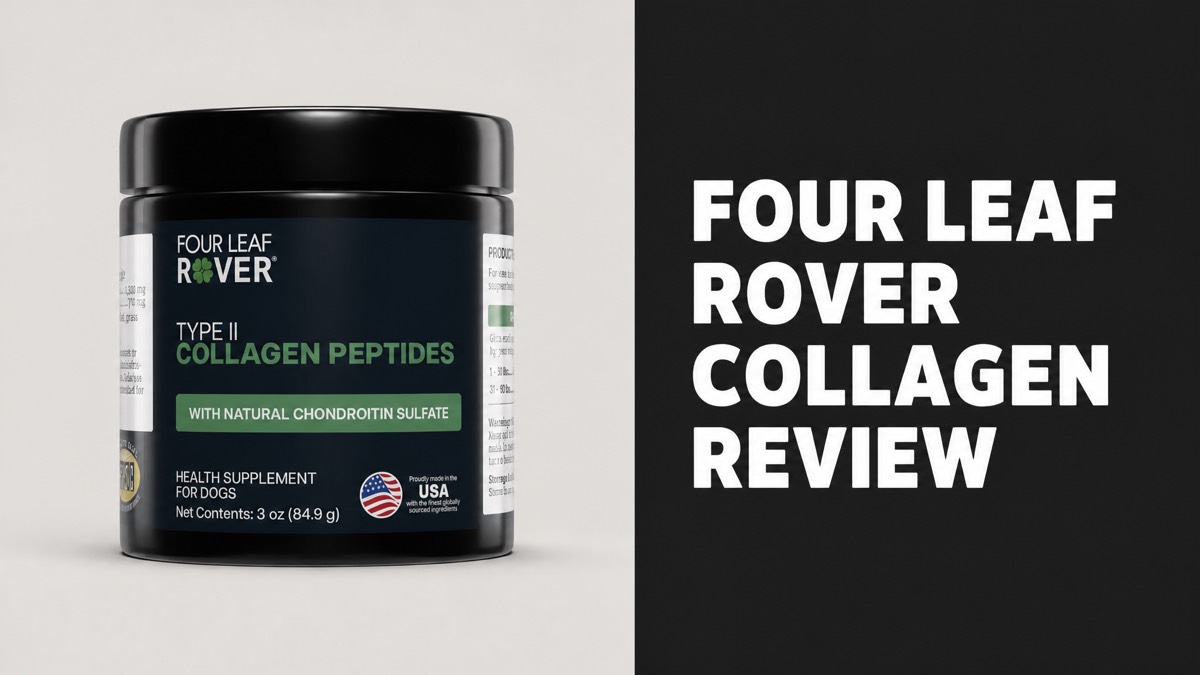
Four Leaf Rover Collagen is a powdered dog supplement made from one ingredient, grass-fed New Zealand beef collagen. The 90 gram jar delivers Type I and Type II collagen for joint, skin and gut support. Owners sprinkle the powder over meals once a day, scaled to their dog's body weight.
The formula carries no fillers and comes from pastured cattle. Dosing runs from half a teaspoon to two teaspoons a day, depending on weight. Owners praise the taste and report softer coats. Joint results split sharply, and the Amazon rating sits at 3.6 stars. Risks center on beef allergy and histamine sensitivity.
The brand cites no clinical research, so the evidence rests on ingredient logic and owner stories. A jar starts at $29.99. This review covers ingredients, dosing, results, complaints and alternatives. Read on to decide whether this powder earns a place in your dog's bowl.
What Is Four Leaf Rover Collagen?
Four Leaf Rover Collagen is a powdered collagen supplement for dogs made from a single ingredient, grass-fed beef collagen. The formula contains Type I and Type II collagen. The brand positions the powder for cartilage, joint and bone support.
The product ships in a 90 gram (3.2 ounce) jar. Owners give the powder orally every day, and most sprinkle it over a meal. The label directions are brief, so Canine Herbalist supplies the weight chart.
Within the brand's range, the collagen is the single-ingredient joint option. Woof Living points to it for dogs with food sensitivities that react to multi-ingredient formulas. The same guide lists it for puppies and senior dogs too.
Who Makes Four Leaf Rover?
Four Leaf Rover sells about twenty dog supplements, including probiotics, mushroom blends, organ powders and joint formulas. Collagen sits beside Hip & Joint and Safe-Sea in the joint category. Amazon lists Hip & Joint and Protect as frequently bought together with the collagen.
La Petite Labs reviewed the brand in 2026. That review names a GMP-compliant Texas plant, a formulator called Dr. Patricia Jordan and NASC membership. The brand also publishes numeric potency guarantees on some mushroom products.
The same review scored the brand 63 out of 100 for public transparency. Does the brand hide its testing? Not exactly, because results are available on request only. The pages also show no clinical citation for finished formulas, so claims rest on ingredient logic.
What Is in Four Leaf Rover Collagen?
The jar contains one ingredient, 100 percent beef collagen with no fillers. Canine Herbalist lists the ingredient the same way. No flavorings, binders or added vitamins appear on the label.
The beef comes from pastured New Zealand cattle. The cattle are grass-fed and pasture-raised, and owners describe the product as grass-finished. The company states that the powder is made in the USA.
Here's the technical part. The collagen is hydrolyzed, meaning it's broken into small peptides. The powder carries naturally occurring chondroitin sulfate. The formula also lists the amino acids glycine, proline and hydroxyproline.
Label Facts:
- 100 percent beef collagen
- Pastured New Zealand cattle
- Hydrolyzed into peptides
- Naturally occurring chondroitin sulfate
- Glycine, proline and hydroxyproline
Why Do Collagen Types I and II Matter?
Type I collagen supports the skin, tendons and digestive tract. The brand ties this type to coat quality and gut lining strength. The formula delivers Type I alongside Type II.
So what does Type II do? It sits mainly in joint cartilage, and cartilage cushions the joint during movement. The brand links Type II to stiffness and mobility. Many joint formulas feature this type for that reason.
But hydrolyzed collagen has a limit. Journeys Holistic Life notes that broken-down collagen may not match the targeted joint effect of UC-II. Powders like this one work as general building blocks.
How Does Four Leaf Rover Collagen Work?
Collagen is the most abundant protein in a dog's body. The protein holds joints, bones, skin and gut lining together. Natural production declines as dogs age, and stiffness often follows.
Here's why: hydrolyzed peptides absorb easily after a dog swallows the powder. The body then uses those peptides and amino acids as building blocks. Glycine, proline and hydroxyproline support tissue repair and collagen formation.
The bottom line? Evidence for the finished product stays thin. La Petite Labs found no study or journal reference on the brand's pages. The mechanism is plausible, but the brand hasn't proven it with published trials.
How Much Four Leaf Rover Collagen Does a Dog Need?
Dosing scales with body weight in teaspoons per day. Canine Herbalist lists one half teaspoon daily for dogs from 1 to 30 pounds (0.5 to 13.6 kilograms). Dogs from 31 to 60 pounds (14 to 27 kilograms) get three quarters of a teaspoon.
Dogs from 61 to 90 pounds (27 to 41 kilograms) take one to one and a half teaspoons. Dogs over 100 pounds (45 kilograms) take two teaspoons. The chart skips the 91 to 100 pound range.
Daily Dose by Weight:
| Dog Weight | Daily Dose |
|---|---|
| 1-30 lb (0.5-13.6 kg) | 1/2 tsp |
| 31-60 lb (14-27 kg) | 3/4 tsp |
| 61-90 lb (27-41 kg) | 1 to 1.5 tsp |
| 100+ lb (45+ kg) | 2 tsp |
Canine Herbalist advises giving the powder away from meals. Still, several owners sprinkle it on food without trouble. One owner says the dose runs well above other supplements they've used.
What Are the Benefits of Four Leaf Rover Collagen?
The brand claims support for joints, ligaments, skin, coat and the gut lining. The brand also lists nails and connective tissue. The marketing frames the product as whole-body support from nose to tail.
Claimed Benefits:
- Joint and ligament support
- Healthier skin and coat
- Stronger gut lining
- Nail and connective tissue support
Here's the catch: claims remain claims. Canine Herbalist notes that the statements haven't been evaluated by the FDA. So is there proof behind the list? No linked research backs it.
The target audience is wide. Copy names senior dogs, arthritic dogs, dogs recovering from injury, dogs with dry skin and growing puppies. And a product pitched at everyone earns some skepticism.
How Well Does It Support Joints?
Owner results split sharply on joint support. One owner gave the powder to a 12-year-old, 5 pound Chihuahua with patella and hip issues. After two months, the dog took three small walks a day without trouble.
Other owners saw nothing. The owner of an 11-year-old mobility-challenged Labrador reports no change. A second buyer saw no improvement after a two-month supply.
Combination use clouds the picture. One senior dog improved while taking several supplements together. Who gets the credit? The owner credits the mix, so the collagen's own share stays unclear.
Can It Improve Skin and Coat?
Coat results look more consistent than joint results. A Catahoula owner reports softer skin and less dryness. Another owner describes a softer, shinier coat after regular use.
Shedding changed in one case. The Chihuahua owner noticed far more hair in the sink after two baths. The dog later looked filled out to clients who see him often.
Type I collagen explains the logic, since the type supports skin and coat structure. Owner reports match the brand's claim. They're still personal observations, not proof.
What Do Four Leaf Rover Collagen Reviews Say?
The Amazon listing holds a 3.6 out of 5 rating from 39 ratings. Amazon shows more than 100 purchases in the past month. The listing ranks number 400 in Dog Hip & Joint Care.
Why is the average so middling? The written reviews split into two camps. Strong mobility and coat stories sit next to flat reports of no change.
Smaller retail pages add little. The Organic Dog Shop lists a single five-star review praising flavor and joint help. One review can't offset the Amazon spread.
What Do Owners Like?
Owners praise how easily dogs accept the powder. Dogs eat it over their meals without fuss. Does smell get in the way? The powder carries no strong smell and mixes in easily.
One owner found a younger dog eating it from the container. Another sprinkles it over picky eaters' bowls and the food disappears. Palatability is the most reliable positive.
Sourcing earns praise too. Buyers like grass-finished beef, the short ingredient list and the USA label. And several credit the product with freer movement and a better mood in senior dogs.
What Are the Common Complaints?
The loudest complaint is a lack of visible results. Some owners saw no change after two months. Others call the purchase a waste and decline to reorder.
Freshness drew one warning. A buyer received a jar in May with a June 2025 expiration date. Why does that matter? Old stock undercuts the value of the jar, and the buyer now orders directly from the brand.
Size and dose draw smaller complaints. One owner wishes for a bigger container at this price. Another notes that the dose runs larger than comparable products.
Common Complaints:
- No visible results after two months
- Jar shipped close to its expiration date
- Small container for the price
- Larger dose than other products
What Are the Risks of Four Leaf Rover Collagen?
The main risk is histamine sensitivity. Canine Herbalist warns that collagen can aggravate histamine. Which dogs does that affect? The shop urges caution for dogs with a sensitivity or with MCT or MCC.
The good news? The formula has a clean profile otherwise. One ingredient means no additives to react to.
Disclaimers repeat one message. The product doesn't replace veterinary care. Owners with a sick dog need a veterinarian's input first.
Which Dogs Need Extra Caution?
Beef-allergic dogs need a different product. The powder is 100 percent beef collagen. A beef allergy rules it out.
Histamine-sensitive dogs form the second group. Canine Herbalist flags them directly. A trial dose and a vet check make sense there.
Dogs with diagnosed joint, gut or kidney conditions need professional guidance. The brand makes no treatment claims. The statements on retailer pages carry no FDA evaluation.
How Much Does Four Leaf Rover Collagen Cost?
A single 90 gram jar costs $29.99 on Amazon. Four Leaf Rover sells it directly through Amazon. The listing works out to $0.33 per gram.
Subscribe & Save lowers the price. The recurring price is $26.99, or $0.30 per gram. Amazon also shows a $25.49 tier with 15 percent savings.
Price Options:
| Option | Price | Per Gram |
|---|---|---|
| One-time purchase | $29.99 | $0.33 |
| Subscribe & Save | $26.99 | $0.30 |
| Subscribe & Save, 15% tier | $25.49 | $0.28 |
Other retailers match the one-time price. The Organic Dog Shop lists $29.99 as well. Buying direct from the brand is the route one buyer chose after an expiry problem.
How Does Price Compare With Value?
Value depends on dog size. The dose scales by weight, so a large dog empties the 90 gram jar much faster. What does that do to value? Small dogs stretch one jar across many weeks, so dog size decides it.
One owner wishes the jar were larger for the price. That view fits big-dog households.
But the single ingredient helps the case. Nothing in the jar is filler. The price reflects collagen alone, with New Zealand sourcing included.
How Does Four Leaf Rover Collagen Compare With Alternatives?
Amazon lists several joint competitors beside this product. PupFlex+ and Now Pets UC-II use undenatured type II collagen. Fera Pets sells a collagen powder with UC-II and five collagen types.
Sibling products from the same brand overlap. Hip & Joint combines eggshell membrane, green-lipped mussel and curcumin. Safe-Sea offers green-lipped mussel oil as a daily omega option.
Alternatives at a Glance:
| Product | Format | Key Ingredient |
|---|---|---|
| PupFlex+ | Soft chew | UC-II collagen |
| Now Pets UC-II Advanced | Chewable tablet | UC-II collagen |
| Fera Pets Collagen Powder | Powder | UC-II, five collagen types |
| Four Leaf Rover Hip & Joint | Supplement | Eggshell membrane, mussel, curcumin |
Glucosamine chews fill out the field. Life4Legs, PENPEN and Vetoquinol Flexadin appear as similar brands. Those chews trade a single-ingredient powder for multi-ingredient formulas.
How Does It Differ From UC-II Collagen?
UC-II is undenatured type II collagen from chicken sternum cartilage. Sellers describe a mechanism called oral tolerance. The immune system learns to dial down attacks on joint cartilage.
The studied dose is tiny. How tiny? Seller content cites about 40 milligrams a day, regardless of dog size. Four Leaf Rover Collagen uses teaspoons of hydrolyzed beef collagen instead.
The two products work by different routes. Hydrolyzed collagen supplies building blocks, while UC-II signals the immune system. Sellers cite trials where UC-II beat glucosamine and chondroitin. Those sellers also sell UC-II, so the claim needs independent confirmation.
Four Leaf Rover Collagen: Final Verdict
Four Leaf Rover Collagen is a reasonable single-ingredient option, not a proven joint treatment. The pros are real: one beef ingredient, New Zealand sourcing and strong palatability. Several owners report better mobility and a softer coat.
The cons are equally real. The Amazon rating sits at 3.6 stars. The brand cites no clinical research, results vary by dog, and one buyer received an old jar.
Pros:
- One beef ingredient with no fillers
- Grass-fed New Zealand sourcing
- Easy for dogs to accept
- Mobility and coat reports from several owners
Cons:
- 3.6 star Amazon rating
- No clinical citation
- Uneven results between dogs
- Jar empties quickly for large dogs
Short answer: it's a fair trial for the right dog, nothing more. The jar empties quickly for large dogs, which raises the monthly cost. Beef-allergic and histamine-sensitive dogs need a different plan.
Who Is It Best For?
The best fit is an owner who wants a short ingredient list. Dogs that react to multi-ingredient formulas suit the powder. Senior dogs and growing puppies are the groups the brand names most.
A poor fit includes beef-allergic dogs. Owners who want clinical proof also suit other products. UC-II formulas pitch published trial data instead.
Coffee Loving Card Makers is a reader-supported platform. Purchases made through our links may earn us an affiliate commission at no extra cost to you. Learn more.